
Reflections from EDA's Brisbane Roadshow Event 2026
By Julia Callaghan
Reflections from EDA’s Brisbane Roadshow 2026
Economic Development Australia’s National Roadshow in Brisbane was more than a valuable networking and learning opportunity. It was a timely reminder that Australia’s regional economic future depends on how well we understand place and plan for 50 years into the future. As a local sponsor and participant, I was pleased to be part of a conversation.
I’ve taken the liberty of relaying the takeaways and their implications for green growth.
Why Exponential Thinking Matters for Regions
Impact investor Lisa Andrews set the tone with a compelling keynote on the mindset and technology we need to adopt for impact. She challenged us to move beyond linear planning and adopt mindsets that can accelerate technology adoption and system‑level change. Her example of being both a futurist and impact investor demonstrates we need to not just think about new tools, but deploy new ways of organising capital, institutions, and incentives to deliver outsized positive impact.
There is so much green and enabling technology available—and so many reasons for optimism—but its development and deployment must be guided by principled care. Without care, the risk of unintended consequences is real, particularly when changes ripple through communities and environments that are already vulnerable.
From a resilience perspective, we should ask: how do we harness exponential thinking in ways that strengthen ecosystems—natural and social capital for value added green industries that at the same time as improve economic productivity.
Place-Based Strategy and the Power of Unique Value Propositions
Paul Cranch, a respected thought leader in investment attraction, emphasised the importance of focus in economic strategy. Rather than spreading effort across too many priorities, he challenged regions to clearly identify and deliberately leverage their unique value propositions.
In practice, this is more difficult than it sounds. Unique value propositions are rarely captured by marketing slogans alone; they are typically embedded in the natural endowments, histories and capabilities that have shaped a region over generations. Importantly, this includes natural capital. Understanding and protecting the natural systems on which regional economies depend is not a constraint on development but a source of enduring competitive advantage.
As strategic and land‑use planning moves through to investment decisions, a clear articulation of place‑based assets helps align public and private effort towards productivity. This alignment is critical for the emergence of new green industries, which tend to be highly place‑specific—drawing on local ecosystems, resources, skills and infrastructure. Regions that understand the full suite of capital already present—natural, social, institutional and economic—are better positioned to identify where green industries can take root and to attract investment that builds on, rather than undermines, those foundations.
The Sunshine Coast: Innovation and Stewardship as an Economic Strategy
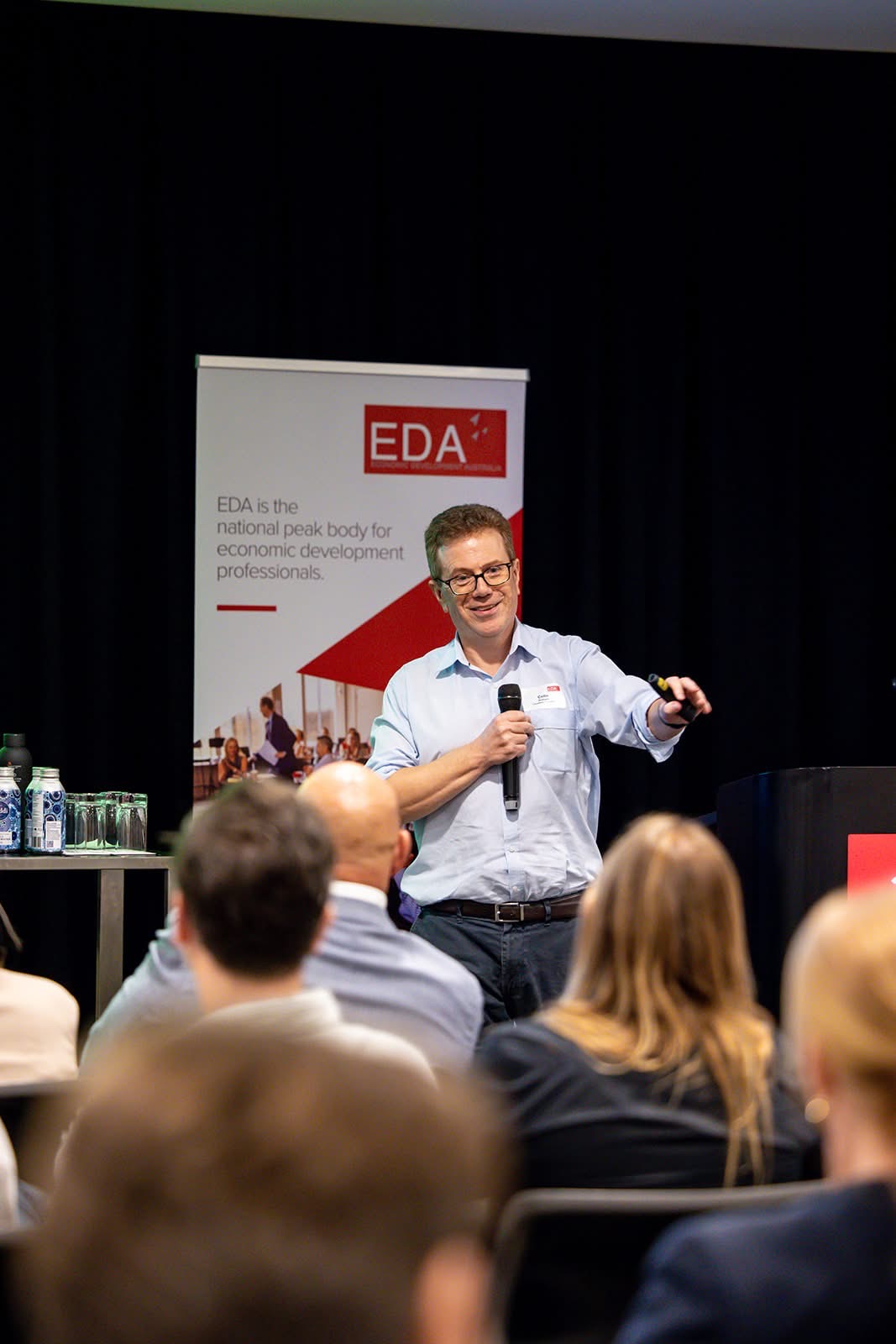
The Sunshine Coast is a powerful case study in long‑term, stewardship‑led innovation. Drawing on five decades of foresight and investment on the coast, Colin Graham illustrated how deliberate planning decisions have translated into sustained job creation, a growing knowledge economy, and improved health outcomes.
Anchor institutions such as the University of the Sunshine Coast and associated hospitals have played a critical role, creating employment pathways while attracting complementary investment. These outcomes have been further strengthened by enabling infrastructure, including a high‑speed, deep‑sea internet cable that has encouraged technology companies and digital innovation to locate in the region.
From a natural capital perspective: what distinguishes the Sunshine Coast from many other regions in South East Queensland is its long‑standing sensitivity to the natural environment. While early agricultural industries—sugar, horticulture, dairy, and timber—shaped the landscape, the region’s evolution into a tourism hub was accompanied by a stronger community commitment to environmental stewardship. Today, the Sunshine Coast and Noosa are internationally recognised for preserving natural beauty while growing the economy—an outcome that was neither accidental nor inevitable.
I recall participating in early innovation ecosystem conversations through ECOllaboration, where there was a conscious effort to ensure that economic ambition sat alongside stewardship of land and water. The types of approaches used by the Sunshine Coast’s Food and Agribusiness Network members is a clear testament to what can be achieved when care for nature is built into production and growth strategies, rather than treated as an externality.
Landuse planning and long term productivity
The economic productivity and social dimension of economic development was highlighted by Kerrianne Haggie’s exploration of data‑driven job ecosystems. Her analysis covered the profound intergenerational impacts of urban development patterns that separate housing from employment centres.
According to Kerrianne’s research the effects compound over time:
- First generation - fewer local jobs, longer commutes, insecure work, reduced disposable income, and less time for family interaction.
- Second generation - limited exposure to career pathways, lower skills attainment, and weaker workforce attachment.
- Third generation - entrenched disadvantage and increased welfare dependency.
These patterns are not only socially inequitable—they are economically inefficient. Low productivity is the inevitable outcome when talent is disconnected from opportunity. As both an ESG professional and an economic developer, this intersection of social outcomes and productivity resonated deeply with my motivations.
What This Means for Green Growth
Overall, the day reinforced the imperative for strategic planning, place‑based job creation, via technology and investment frameworks that integrate exponential growth with measurable impact.
What became increasingly clear is that green growth is not a niche agenda—it is the logical evolution of economic development once we fully account for the systems on which our economies depend. The role of natural capital—was assumed as the basis for our economies and societies. It is worth me making it explicit here.
Natural capital—our land, water, biodiversity and ecosystems—is not simply an environmental consideration to be balanced against growth. It is a productive asset that underpins prosperity, workforce participation, innovation and liveability. Thinking about natural capital helps regions:
- Identify and articulate their unique value propositions
- Inform land‑use planning for housing, industry, and infrastructure
- Build resilient economies that can adapt to climate and market change
The economic professionals in the room were implicitly encouraged to:
- Understand their regional assets in a holistic sense—natural, social, institutional and economic
- Invest with long‑term intention, rather than chasing short‑term growth metrics
- Be active and informed participants in land‑use decisions, recognising their generational consequences
From a green growth perspective, this represents a shift from mitigation to value creation. When development pathways are aligned with natural systems rather than working against them, regions are better positioned to attract investment, deliver quality jobs and avoid the costly trade‑offs that so often emerge later.
If we take seriously the advice shared by speakers at the Brisbane Roadshow—particularly around place‑based strategy and long‑term thinking —we will be far better equipped to deliver growth that is productive, inclusive and resilient. Not just for the next investment cycle, but for the decades ahead.
Latest Articles


Connect with Julia
Subscribe
Stay informed and inspired — subscribe to receive my occasional updates on the actions, insights, tools and events relevant to growing a competitive green economy.

Get in contact
Get in contact
Address
Brisbane,
Queensland
Address
Brisbane,
Queensland